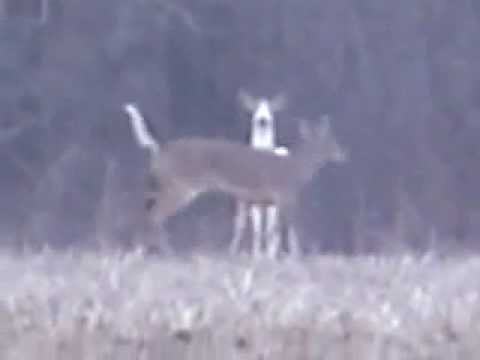
Animal tube | «White Ghosts,» the weird, strange animals that inhabit an Ohio shots in a natural setting of wild, white (piebald) Virginia Whitetails. These rare, unusual animals were photographed in the least 6 white deer were seen at different times in the same area. One was pure white, about a foot taller than the other deer, and had a huge rack. Another deer had a large band or belt of white fur around its middle like a Poland China hog. Its twin was white, but the only time I filmed the white twin was in a split second as it jumped behind a tree (it had been standing by the banded deer and their mother). A white fawn was seen once. Around 30 years ago, many area people saw a white deer with a black spot. A sixth white deer was seen and photographed along our river valley (Alum Creek, in Ohio).The piebald deer also had a sort of Roman nose — one with an enlargement in the front of the face – that some of the deer in the area had. The wooly deer had a whiteish face with white eyebrows. It also seemed to also have an unusually long this video, as many as 3 piebald deer were photographed together-a very rare occurrence. A number of other piebald deer were seen on the farm, as shown in other , albino, «white,» and «black» whitetail deer are very rare. In Bolder Junction, Wis., a man once photographed 3 albino deer standing together. The odds of doing this in wild deer have been calculated as astronomical — 1 in 79 billion. Such calculations are based on assumptions. For example, the odds of finding an albino deer are often calculated as 1 in 30,000. Less than 1 % of whitetail deer are piebald. However seeing either a wild piebald or an albino deer is considered a once in a lifetime experience. Black or Melanistic whitetails are very, very rare, and much rarer than either white piebald or albino deer. A person can recognize a melanistic deer because they produce too much of the pigment known as melanin and this makes them much darker than a typical whitetail. Of the millions of deer taken each year only a very few with melanism have been reported. Most people don’t know they even exist because of their extreme rarity. A melonistic buck is a true trophy. Some melanistic whitetails are very dark and some are even pure black. Only 1 has, so far, been photographed here as shown below:Additional views of wild deer on the farm include:LARGE BUCK FIGHT-LOCK ANTLERS, ENTANGLED, CLOSE WHITETAIL Non-Typical Moose-Sized DEER – ACTION SHOTS RARE WHITE WILD WHITETAIL BUCK views of this white deer: white deer on the farm — the banded one & sibling: white deer being stalked by coyotes: strange deer on the deer bucks run and bucks COYOTES VS. SIX DEER-POUNCE ATTACK KILL PLAY Pt 2 BUCKS 20 TINE ANTLER SHED & HUGE BUCK IN RUT, DEER-RAREST OF ALL, BLACK OR MELANISTIC BUCK deer and white buffalo figure prominently in the legends of people throughout the world. Sometimes these animals are considered ghosts and at other times presage an omen. The Chickasaw, Seneca, Apache, Aztec, Cheyenne, Lenca, Cherokee, Pawnee, Sioux, Shasta, Algonquin, Pawnee, Sioux, Lakota and many other groups have legends about white deer. Such animals are so strange in appearance that they immediately capture interest and make people watch for them. (These were wild deer on our farm taped by Scott and extracted from longer films.)** Some of the world’s largest bucks live in Ohio. Some of its world champion bucks have Boone and Crockett scores of over 300 points. Ohio’s Beatty Buck may be the (or among the) largest ever taken by a hunter. That title of the largest whitetail, ever, in the record books belongs to the «Missouri Monarch,» a 333-7/8 buck found dead on the side of a road in 1982 near St. Louis. In second place is the legendary «Hole in the Horn,» found dead in Ohio in 1940, however, many whitetail experts think that it is actually the largest set of whitetail deer antlers in history. It may be the most famous whitetail have an amazing assortment of communicative signs. Approximately 100 different vocalizations have been recorded, such as tending grunts, dominant grunts, bleats, and many others. They make extensive use of sign language. | Video tube
Δημοσίευση σχολίου